This time, I published the review over at Captain Blue Hen's website:
Jim's Comic Reviews: The Elle Word
I said as much on Jim McCann's G+ page, but I think it was in issue #3, the scene where Jo is dancing on the bed after receiving a psychic tweet from Elle in a dream, where it hit home for me how human and believable the characters are as written. Those types of reactions are not things that occur to every writer of comics, especially in the superhero-centric genres, but McCann really inhabits and empathizes with his characters. I know Mind The Gap was originally envisioned for television, and this seems to come through in the settings and scenery...which leads me to wonder about comparisons with McCann's more comic-oriented efforts.
Thursday, February 14, 2013

Wednesday, February 13, 2013
Ann Nocenti Talks Katana, Kurasowa and the Changes She’s Seen in Comics
Re-post from DC Women Kicking Ass, a rather good interview with Ann Nocenti on Katana, among other things:
Ann Nocenti Talks Katana, Kurasowa and the Changes She’s Seen in Comics
Ann Nocenti Talks Katana, Kurasowa and the Changes She’s Seen in Comics
Wednesday, February 6, 2013
Jim's Comic Reviews: Fatale (collected trades, Book One: Death Chases Me and Book 2: The Devil's Business)

Many reading this are already familiar with Ed Brubaker's work at the big two publishing houses, and were dismayed (perhaps only momentarily) by his announcement mid-year to part ways with Marvel. His iconic runs on Captain America and Winter Soldier stand out in recent memory, the latter of which continued until just last month. Rumors surrounded various possible creative paths Brubaker could take, but comics fans were assuaged in November, when he announced his intention to turn Image Comics' Fatale into an ongoing series. The title, another collaborative effort between Brubaker and artist Sean Phillips, was originally intended for three parts in perhaps fourteen issues.

I'm late to the party on this title, but here to review the first two trades: Book One: Death Chases Me, and Book 2: The Devil's Business, collecting issues 1-5 and 6-10, respectively.
Book One introduces us to the character of Josephine, central figure of the story and a woman of some mystery. It's gradually revealed that she's been around this world longer than your average human is entitled, and sinister supernatural forces are both her strength and her nemeses. She exhibits an almost hypnotic power over men, who are drawn to her like moths to a flame. Three such men, Nick, Dominick, and Walter, form chapters in her long life, each coming to know her romantically, finding himself in her thrall, and falling prey in some way to the strange and evil figures who pursue her through the decades. Book Two delves further into Josephine's history, giving snippets and clues as to her nature and that of her pursuers, a midst a more urgent tone.
Brubaker's storytelling, at the onset, seems eerily disjointed. As the plot thickens, however, the episodic and out-of-sync narrative falls into a skittish rhythm that lends to the air of noir and mystery. It's absolutely thick with inter-twining fates and plot threads spanning the years, and paced expertly to deliver in every chapter. Part of the richness is delivered through the settings, from the 50's detective noir that dominates Book One, to a drug-centric, post-hippie view of the 70's in Book Two. It's in Book Two, particularly, where I took note of just how much the period was in evidence in the tale. Here, the cult-spawning pop culture fascination with figures like the Manson family, and the drug-fueled orgies that belie the cultural innocence lost in the previous decade, are the backdrop for something even more sinister. It's amazing how the tone of the story is tweaked carefully from one decade to the next, and how Brubaker's conscious use of verbal idioms and other indicators in the dialogue and character actions plant the story firmly in those periods.
Phillips' art lends well to this story. Although I wouldn't like him for some of the more flashy super-hero types, I think he's well suited for period pieces, horror and noir, with his thick shadows, carefully selected essential details, and expressive faces, all telling no more and no less than that which is useful to story and mood. This guy moves faces masterfully, and each simple line is crafted to belie tone, emotion, ethnicity, lighting, and even the uncanny madness of the Lovecraftian villains. He's got that indispensable skill of an artist that allows you to almost see the photo-realism he imagined beneath the simple, stylized lines he delivers. Panel sizes are small and lean towards a more dense narrative than most modern comics. At times I wished for more novel layouts, but when the story is this thick, the art must follow.
Finally, the careful, often muted color tones delivered by Dave Stewart are perfect for this story. There were one or two instances where I wished I was seeing more widely ranged use of color, but I'd hesitate to recommend him anything in that regard lest the story suffer for more detail than is necessary. The eye is drawn to the right places, and the color composition all lends to story flow, and, well, it's just wonderful.
Lest I gush further, let me just say that I'm thoroughly loving this tale: It has the best elements of a pulp novel mixed in with some awesome imagery and epic plot. I'm hopeful for any way the work might continue into at least another year, as I feel the story has the legs (no pun intended) to do it. It's a definite recommended read from me.
Tuesday, January 22, 2013
My Experience With ICL (Implantable Collamer Lens)
This entry is a little break from the norm. Rather than bring you some attempt at insightful commentary on whatever comic book or movie has last tweaked my fancy, this one is a little more personal and a little more technical, so bear with me.
Recently, after consult with my eye doctor and a specialist in the field, I made the decision to have contact lenses permanently implanted in my eyes. I've worn glasses since the third grade, and I couldn't function without corrective lenses. The idea of waking up in the morning without fumbling around for the damn things seemed like the best thing one could wish for.
The procedure, known by most by the equipment nomenclature, is referred to as "ICL", which stands for Implantable Collamer Lens. In the procedure, a lens very similar to a contact lens is implanted behind the iris, but in front of the eye's natural lens. It's completely invisible to the naked eye, and corrects for nearsightedness. It's a procedure based on, and somewhat similar to, the surgery used to treat cataracts.
There are several advantages and disadvantages between ICL and the more common Lasik procedure for correction of myopia. Lasik is a procedure where a laser is used to re-shape corneal tissue (the outside layer of the eye, that you can touch with your finger). Lasik is cheaper, and by nature less invasive...nothing is inserted into the eye. This eliminates the small chance for some side effects such as cataracts that can occur when anything is implanted into the eye. Modern Lasik procedures can also correct for astigmatism, which is what you get when there are irregular imperfections in the shape of the eye and it's focusing mechanisms that can't be compensated for with a single, across-the-board prescription. The ICL version of astigmatism correction isn't approved yet. Lasik is also cheaper than ICL by a fair margin, although they're in the same ballpark.
There are some advantages to ICL that Lasik doesn't have. Lasik removes eye tissue to produce a new shape, like whittling away at a sculpture. You can't replace this tissue and start over. While Lasik can be fine-tuned in one direction, giving you further correction, you can't really dial it back, whereas the ICL procedure is completely reversible. ICL can also compensate for a wider range of prescriptions, and may be the only choice for correcting people whose corneas aren't the shape or thickness required for Lasik.
The way things stand now, most ophthalmologists will point toward Lasik for people who qualify, with ICL being the back-up for those who aren't Lasik suitable for whatever reason.
I was measured for suitability for both procedures. My first visit to the ophthalmologist included a battery of tests to map the shape and thickness of my corneas, determine my prescription, and examine my eyes for suitability for the ICL implant. The measurements came back okay for either procedure. While my prescription is at the lower end of what they suggest for ICL, and my corneal thickness was more than adequate for Lasik (more on that later), my corneas were apparently flat enough that the doctor left both options open to me. I liked the idea of a reversible procedure enough that I chose the ICL over Lasik. They scheduled me for an additional consultation, where everything was re-mapped and re-measured, and from there I scheduled the first of two surgical procedures for the following week. The entire process took place across about 6 weeks.
An ICL operation actually consists of two procedures. In the first procedure, usually a week or so prior to the actual implant, a laser is used to cut a small opening at the edge of each iris (called YAG laser iridotomy). This allows fluid inside the eye to flow among and around the implanted lens, which is necessary for proper placement. The second procedure is the actual implant of each lens, where a small incision is made in each eye, the lens itself is folded for insertion and basically released into the pierced chamber and allowed to unfold in front of the eye's natural lens.
My Experiences:
I came in for my YAG iridotomy on a Tuesday, having taken the day off work to have the procedure. The iridotomy was to be a simple procedure lasting a few minutes each eye, involving 5 quick and relatively painless jolts with a laser to create the necessary opening. I had been told previously that I'd be getting a dose of Valium prior to, as a calming agent, as having one's eye cut with a laser freaks some people out. Once there, however, I was assured this was not the case, and that Valium was usually not administered until the final insertion procedure.
Had I known what was coming, I'd have demanded their highest dose of whatever calming agent was available.
Before the iridotomy, they placed drops in my eyes designed to contract the pupil, then observed me in a dark room while I lay comfortably in a chair. Once the drops had taken, I was escorted to the operating room. I was seated upright on a stool and my head placed in a chin rest and headband apparatus similar to what an eye doctor uses for routine exams. I was directed to hang on to two stationary handles that looked like the joysticks on an old style arcade machine. It was at this point that several obstacles concerning my physiology that made the iridotomy difficult became apparent: Apparently, my eye sockets are fairly well-recessed, and I have a prominent chin. Whether this indicates a large frontal lobe of the brain and facial features like those of my comic-book heroes, or if it is, instead, a throwback to my cro magnon ancestry, I'll leave you to judge. My melon just didn't fit in the thingey real good.
The doctor, seated in front of me behind some sort of Jack Kirby-inspired mechanism of scientific endeavor, observed my eye through a system of telescopes, mirrors, and supremely bright lights, and began to announce, repeatedly, that my head must come forward. He needed an angle coming from the side of the eye closest the bridge of the nose and moving outward, and the nose was in the way. The nurse, behind me, tried to comply with his increasingly distressed announcements by placing both hands behind my head and bearing down on it with at least a considerable portion of her own body weight. The problem seemed, to me, entirely due to the rather unyielding steel head band and chin rest in direct contact with my inflexible, cro magnon skull, and further complicated with the fact that even if my skull were to give way and be forced entirely through the "rest", my nose would presumably move forward with it. My head proved completely resistant to her efforts to shove it through the apparatus like a potato through a drain pipe, but the doctor needed a better angle, so the efforts continued. I quickly gathered that the object was not to move the head forward, but rather, to cause the eye by compression of the skull to bulge forth in its socket. What else, by virtue of the transitive effect of the motion of the skull imparted to the nose, could they be trying to accomplish?
In the mean time, my eye was fitted with a monocle-like device, which was covered in gel and placed directly on the eye around the iris. This, I think, was to facilitate coupling the laser to it's target, and give a scope through which the doctor could observe the results. The doctor, in a seeming bid to increase the pressure on the eyeball but prevent it from popping out of its socket, fought the forward pressure the nurse applied with pressure against the surface of the eye with the monocle. This was excruciating.
The doctor seemed resigned to it after five or ten minutes of wrestling (I call it that, although I don't think I moved a single millimeter the entire time), and began his attempts at the laser cut. This, as I was told prior to the procedure, should have been 4-5 quick zaps with the laser in each eye, some minor discomfort, and done. After 15 minutes and about 35 zaps on the first eye, each of wish increased my discomfort along an exponential curve from "Shit!" to "Fuck!" to "FUCK YOU!", I was done. With the first eye. I was thankful, and at least prepared, I thought, for what was to come.
The second eye was much more difficult. I lost count after 60 laser shots, and I'm sure I scared at least 3 potential customers out of the waiting room with my cursing the doctor, his nurse, and the lack of vallium or more potent sedatives, my bulging eye, and anything else I could seize on and malign for its existence. The nurse was appropriately horrified by the whole thing, and said later that she'd never seen anyone take that many shots to complete. Nevertheless, the doctor did eventually call it quits. Between eyes, the doctor had announced that I had the thickest corneas he'd ever seen, and that this was preventing the laser from creating the size opening they needed. That, and not being able to get my head in the proper position. From that point, I had to reschedule another procedure that Friday, to enlarge the opening in the left eye the doctor had managed to create.
Recovery from the first procedure was about 6-8 hours, for me, before what was soreness subsided to a dull ache. The next day, I returned to work with slightly reddened, irritated eyes that lasted the working day.
Friday's appointment went much better. It had occurred to me since the first procedure that a slight tilt of the head to the side and perhaps being allowed to come out of the chin rest a bit would have given the doctor the better angle needed to do the job. This was confirmed on the second visit, when the nurse asked me to do the same prior to me suggesting it. Once allowed to re-situate my head a bit, the procedure went off just as expected: Five shots and done, with only mild discomfort. They had offered me a mild dose of Valium for that portion of the procedure, however. I took it. It's not a painkiller, but there was less cursing and I exhibited what you would call a sunny disposition as I left. I was informed that that was the way things were supposed to have gone on the previous visit, and I remember thinking how alike Friday's visit was to what they described on Tuesday.
The following Monday, I came in for the last procedure: The insertion of the lenses. The regimen of numbing and dilating drops I was given was much more elaborate, and I was offered, and given, the strongest dose of Valium they could safely give me prior to the procedure. After an hour or so of observation of my eyes' compliance with the drugs, I was escorted to the operating room and allowed to lie back in a long, dentist-style chair. My right eye was first covered with adhesive paper cloth sheet that extended over my face, then exposed by virtue of a tear-away, eye-socket-shaped cutout that was removed to allow the procedure. During the procedure, the incision was made at the side of the iris opposite the opening made the previous week, the folded lens was inserted into its proper place, and various squeezing and manipulation was done to the eye to situate it. There was a level of discomfort; I'd liken it to that one experiences with a drill-and-fill dental procedure, but it was nothing to be worried about.
By far the most disconcerting part of the procedure was during the insertion. You are asked to fix your eye on a point throughout the procedure, but even as your eye is fixed, the images you see swim and convolve like paint behind a stir stick...often, what you are focused on, without moving your eye at all, moves completely out of your field of view. The only things you see with any clarity, really, are the (often sharp) instruments coming into proximity of your eyeball. You feel a stinging on the side of the insertion, and you can feel the insertion itself and manipulation of the eyeball by the doctor (I think he squeezes fluid around the lens once it's inserted), but these are dull aches, and not overly discomforting. At random intervals throughout the procedure, the nurse is asked to irrigate the eye, which actually feels cool and refreshing.
The procedure takes about a half hour each eye, but the vast majority of this is the doctor folding the lens and otherwise fiddling with equipment. The actual insertion process takes place over the course of five minutes for each eye. Once the first eye is completed, there is a lull prior to the second beginning, as the doctor observes the proper fitment and disposition of the lens in the eye. It is at that point that most notice a change in the way things focus for that eye, although the ability to bring things into sharp focus is diminished through most of the first day.
My procedure lasted from noon until about 2:30 p.m., and although I noticed the change in visual acuity during the car ride home, I didn't get the full effect until about 9 p.m. that night. This morning, the day following the procedure, I had my follow-up visit with the doctors. I easily read the 20/15 line on the eye chart, and I'd describe my eyes as comfortably working the way a non-myopic person would expect them to work. Occasionally, I have dryness to the right eye, and some sensation of "something in the eye", but to describe it as discomfort would perhaps be too much. This is expected to subside over the coming week. I'm required to wear some guards on my eyes as I sleep for the next two weeks, but these have no arms and are actually more comfortable than the glasses I used to wear. I also have a required regimen of drops to keep to, every four waking hours during the next two weeks. After that, I expect smooth sailing.
Would I do it again, or recommend it to a friend? Yup. Walking around with better-than-20/20 vision is a beautiful thing, and even my atypical experience with the YAG was worth it.
Recently, after consult with my eye doctor and a specialist in the field, I made the decision to have contact lenses permanently implanted in my eyes. I've worn glasses since the third grade, and I couldn't function without corrective lenses. The idea of waking up in the morning without fumbling around for the damn things seemed like the best thing one could wish for.
The procedure, known by most by the equipment nomenclature, is referred to as "ICL", which stands for Implantable Collamer Lens. In the procedure, a lens very similar to a contact lens is implanted behind the iris, but in front of the eye's natural lens. It's completely invisible to the naked eye, and corrects for nearsightedness. It's a procedure based on, and somewhat similar to, the surgery used to treat cataracts.
There are several advantages and disadvantages between ICL and the more common Lasik procedure for correction of myopia. Lasik is a procedure where a laser is used to re-shape corneal tissue (the outside layer of the eye, that you can touch with your finger). Lasik is cheaper, and by nature less invasive...nothing is inserted into the eye. This eliminates the small chance for some side effects such as cataracts that can occur when anything is implanted into the eye. Modern Lasik procedures can also correct for astigmatism, which is what you get when there are irregular imperfections in the shape of the eye and it's focusing mechanisms that can't be compensated for with a single, across-the-board prescription. The ICL version of astigmatism correction isn't approved yet. Lasik is also cheaper than ICL by a fair margin, although they're in the same ballpark.
There are some advantages to ICL that Lasik doesn't have. Lasik removes eye tissue to produce a new shape, like whittling away at a sculpture. You can't replace this tissue and start over. While Lasik can be fine-tuned in one direction, giving you further correction, you can't really dial it back, whereas the ICL procedure is completely reversible. ICL can also compensate for a wider range of prescriptions, and may be the only choice for correcting people whose corneas aren't the shape or thickness required for Lasik.
The way things stand now, most ophthalmologists will point toward Lasik for people who qualify, with ICL being the back-up for those who aren't Lasik suitable for whatever reason.
I was measured for suitability for both procedures. My first visit to the ophthalmologist included a battery of tests to map the shape and thickness of my corneas, determine my prescription, and examine my eyes for suitability for the ICL implant. The measurements came back okay for either procedure. While my prescription is at the lower end of what they suggest for ICL, and my corneal thickness was more than adequate for Lasik (more on that later), my corneas were apparently flat enough that the doctor left both options open to me. I liked the idea of a reversible procedure enough that I chose the ICL over Lasik. They scheduled me for an additional consultation, where everything was re-mapped and re-measured, and from there I scheduled the first of two surgical procedures for the following week. The entire process took place across about 6 weeks.
An ICL operation actually consists of two procedures. In the first procedure, usually a week or so prior to the actual implant, a laser is used to cut a small opening at the edge of each iris (called YAG laser iridotomy). This allows fluid inside the eye to flow among and around the implanted lens, which is necessary for proper placement. The second procedure is the actual implant of each lens, where a small incision is made in each eye, the lens itself is folded for insertion and basically released into the pierced chamber and allowed to unfold in front of the eye's natural lens.
My Experiences:
I came in for my YAG iridotomy on a Tuesday, having taken the day off work to have the procedure. The iridotomy was to be a simple procedure lasting a few minutes each eye, involving 5 quick and relatively painless jolts with a laser to create the necessary opening. I had been told previously that I'd be getting a dose of Valium prior to, as a calming agent, as having one's eye cut with a laser freaks some people out. Once there, however, I was assured this was not the case, and that Valium was usually not administered until the final insertion procedure.
Had I known what was coming, I'd have demanded their highest dose of whatever calming agent was available.
Before the iridotomy, they placed drops in my eyes designed to contract the pupil, then observed me in a dark room while I lay comfortably in a chair. Once the drops had taken, I was escorted to the operating room. I was seated upright on a stool and my head placed in a chin rest and headband apparatus similar to what an eye doctor uses for routine exams. I was directed to hang on to two stationary handles that looked like the joysticks on an old style arcade machine. It was at this point that several obstacles concerning my physiology that made the iridotomy difficult became apparent: Apparently, my eye sockets are fairly well-recessed, and I have a prominent chin. Whether this indicates a large frontal lobe of the brain and facial features like those of my comic-book heroes, or if it is, instead, a throwback to my cro magnon ancestry, I'll leave you to judge. My melon just didn't fit in the thingey real good.
The doctor, seated in front of me behind some sort of Jack Kirby-inspired mechanism of scientific endeavor, observed my eye through a system of telescopes, mirrors, and supremely bright lights, and began to announce, repeatedly, that my head must come forward. He needed an angle coming from the side of the eye closest the bridge of the nose and moving outward, and the nose was in the way. The nurse, behind me, tried to comply with his increasingly distressed announcements by placing both hands behind my head and bearing down on it with at least a considerable portion of her own body weight. The problem seemed, to me, entirely due to the rather unyielding steel head band and chin rest in direct contact with my inflexible, cro magnon skull, and further complicated with the fact that even if my skull were to give way and be forced entirely through the "rest", my nose would presumably move forward with it. My head proved completely resistant to her efforts to shove it through the apparatus like a potato through a drain pipe, but the doctor needed a better angle, so the efforts continued. I quickly gathered that the object was not to move the head forward, but rather, to cause the eye by compression of the skull to bulge forth in its socket. What else, by virtue of the transitive effect of the motion of the skull imparted to the nose, could they be trying to accomplish?
In the mean time, my eye was fitted with a monocle-like device, which was covered in gel and placed directly on the eye around the iris. This, I think, was to facilitate coupling the laser to it's target, and give a scope through which the doctor could observe the results. The doctor, in a seeming bid to increase the pressure on the eyeball but prevent it from popping out of its socket, fought the forward pressure the nurse applied with pressure against the surface of the eye with the monocle. This was excruciating.
The doctor seemed resigned to it after five or ten minutes of wrestling (I call it that, although I don't think I moved a single millimeter the entire time), and began his attempts at the laser cut. This, as I was told prior to the procedure, should have been 4-5 quick zaps with the laser in each eye, some minor discomfort, and done. After 15 minutes and about 35 zaps on the first eye, each of wish increased my discomfort along an exponential curve from "Shit!" to "Fuck!" to "FUCK YOU!", I was done. With the first eye. I was thankful, and at least prepared, I thought, for what was to come.
The second eye was much more difficult. I lost count after 60 laser shots, and I'm sure I scared at least 3 potential customers out of the waiting room with my cursing the doctor, his nurse, and the lack of vallium or more potent sedatives, my bulging eye, and anything else I could seize on and malign for its existence. The nurse was appropriately horrified by the whole thing, and said later that she'd never seen anyone take that many shots to complete. Nevertheless, the doctor did eventually call it quits. Between eyes, the doctor had announced that I had the thickest corneas he'd ever seen, and that this was preventing the laser from creating the size opening they needed. That, and not being able to get my head in the proper position. From that point, I had to reschedule another procedure that Friday, to enlarge the opening in the left eye the doctor had managed to create.
Recovery from the first procedure was about 6-8 hours, for me, before what was soreness subsided to a dull ache. The next day, I returned to work with slightly reddened, irritated eyes that lasted the working day.
Friday's appointment went much better. It had occurred to me since the first procedure that a slight tilt of the head to the side and perhaps being allowed to come out of the chin rest a bit would have given the doctor the better angle needed to do the job. This was confirmed on the second visit, when the nurse asked me to do the same prior to me suggesting it. Once allowed to re-situate my head a bit, the procedure went off just as expected: Five shots and done, with only mild discomfort. They had offered me a mild dose of Valium for that portion of the procedure, however. I took it. It's not a painkiller, but there was less cursing and I exhibited what you would call a sunny disposition as I left. I was informed that that was the way things were supposed to have gone on the previous visit, and I remember thinking how alike Friday's visit was to what they described on Tuesday.
The following Monday, I came in for the last procedure: The insertion of the lenses. The regimen of numbing and dilating drops I was given was much more elaborate, and I was offered, and given, the strongest dose of Valium they could safely give me prior to the procedure. After an hour or so of observation of my eyes' compliance with the drugs, I was escorted to the operating room and allowed to lie back in a long, dentist-style chair. My right eye was first covered with adhesive paper cloth sheet that extended over my face, then exposed by virtue of a tear-away, eye-socket-shaped cutout that was removed to allow the procedure. During the procedure, the incision was made at the side of the iris opposite the opening made the previous week, the folded lens was inserted into its proper place, and various squeezing and manipulation was done to the eye to situate it. There was a level of discomfort; I'd liken it to that one experiences with a drill-and-fill dental procedure, but it was nothing to be worried about.
By far the most disconcerting part of the procedure was during the insertion. You are asked to fix your eye on a point throughout the procedure, but even as your eye is fixed, the images you see swim and convolve like paint behind a stir stick...often, what you are focused on, without moving your eye at all, moves completely out of your field of view. The only things you see with any clarity, really, are the (often sharp) instruments coming into proximity of your eyeball. You feel a stinging on the side of the insertion, and you can feel the insertion itself and manipulation of the eyeball by the doctor (I think he squeezes fluid around the lens once it's inserted), but these are dull aches, and not overly discomforting. At random intervals throughout the procedure, the nurse is asked to irrigate the eye, which actually feels cool and refreshing.
The procedure takes about a half hour each eye, but the vast majority of this is the doctor folding the lens and otherwise fiddling with equipment. The actual insertion process takes place over the course of five minutes for each eye. Once the first eye is completed, there is a lull prior to the second beginning, as the doctor observes the proper fitment and disposition of the lens in the eye. It is at that point that most notice a change in the way things focus for that eye, although the ability to bring things into sharp focus is diminished through most of the first day.
My procedure lasted from noon until about 2:30 p.m., and although I noticed the change in visual acuity during the car ride home, I didn't get the full effect until about 9 p.m. that night. This morning, the day following the procedure, I had my follow-up visit with the doctors. I easily read the 20/15 line on the eye chart, and I'd describe my eyes as comfortably working the way a non-myopic person would expect them to work. Occasionally, I have dryness to the right eye, and some sensation of "something in the eye", but to describe it as discomfort would perhaps be too much. This is expected to subside over the coming week. I'm required to wear some guards on my eyes as I sleep for the next two weeks, but these have no arms and are actually more comfortable than the glasses I used to wear. I also have a required regimen of drops to keep to, every four waking hours during the next two weeks. After that, I expect smooth sailing.
Would I do it again, or recommend it to a friend? Yup. Walking around with better-than-20/20 vision is a beautiful thing, and even my atypical experience with the YAG was worth it.
Wednesday, January 9, 2013
Jim's Comic Reviews - Week of 9 January

So, now that we've settled in, what can we glean about the direction Fraction and co. have undertaken with this title? I have to say, it's exactly as expected: The first family of comics is in another realm entirely, disconnected from the events of Earth-616, partaking in adventure of a very Trek or Lost in Space vibe. Bagley's art is competent, Mount's colors are all very whiz-bang, as you'd expect on such a title, and the characters are true to their nature...but I'm a little bored with it, to be honest. The one thing the issue lacks is a complex, motivated nemesis, and the being they encounter instead is very Trek-like and just...well, generic sci-fi. It's all very predictable, and this is one title that's gotta be anything but. The vibe they're going for is "boundless adventure" and what you get is something that, although executed with competence, you've seen before. If 50's and 60's sci-fi nostalgia is what trips your trigger, I'd say give it a look-see, but even then, if you're more Whovian than Trekkie in your taste for weird sci-fi plots you'll want to give it a pass. For myself, I've seen this episode dozens of times, it's just that Shatner was playing his own version of Mr. Fantastic.

Thunderbolts #3
I gotta say, this was a fun read. Way's giving us a motley of characters that are all very broken, and delights in those moments of interplay within the team that make the book what it is. He's one of those few that can get legitimate, consistent hilarity out of the over-used Deadpool, who's played as the perfect foil to everyone else's weighty concerns. Dillon's art is what it is, though...you never want for clues as to the characters' emotional states, and the storytelling, character blocking and composition is all there...but there's an element of same-face to characters and, well, to put it bluntly there's just something wrong with everyone's mouths and eyes. The line weights are just too uniform around facial features and they lack any sense of texture. That, and character movements and poses are all very uninspired. With a character like Red Hulk, for example, I want more "tank-like" and less "slightly taller than Frank Castle, if you check his driver's license" That being said, this title is going on my pull list tomorrow, great art or no.

Jim Butcher's The Dresden Files: Ghoul Goblin #1
Apparently, there's a set of novels and a tv show about this Dresden guy, and I've never seen any of it...go figure. I'm judging the work as an introduction to a reader who's starting out cold, so fans should bear that in mind. Love the art work in this issue: the Cooper/Mohan team gives us images well suited for the story, which concerns the adventures of Harry Dresden, Wizard-For-Hire. Now, that's a job title that just screams for a unique character and a bizarre plot to go with it. While the plot here seems original in it's underpinnings, the execution is rather flat. I haven't followed the character in works past, so maybe there's back-story and motivation I'm unaware of that fans will just "get", but I didn't think the book did a convincing job of laying out the basics. I'm thinking they were going for "hard-boiled" and "noir-ish", but they end up with a sort of faceless guy who deals in the fantastic in a way that's very parochial. I don't recommend it as an introduction for non-fans of the character, but I'd guess that long-time fans might like it.

Batman Detective Comics #16
While the issue is without the mask cover of the other, sometimes more relevant, pieces of the Death Of The Family crossover event, it does have the crossover billing over the marqis. I suppose the guts of the story kinda depend on DotF going on, but it's definitely a side-line arc that could have, with a few tiny tweaks, ended up well outside the bounds of the crossover. Nevertheless, Layman once again lays out a tight, engaging script that's perfectly suited for the title, and could definitely stand as it's own story. An up-and-coming villain is bent on taking control of the Gotham crime syndicate currently headed by the Penguin, and he's definitely proving himself willing to embrace Gotham's own brand of intricate, violent weirdness to do it. Layman is setting us up for many issues to come, and it's a fun ride. The art is pretty stellar, too.

Just go buy it already. I can't believe Marvel is putting out such consistent quality with this title at such a fast pace. Probably the best run of Thor since JMS was on the character a few years back, and I daresay it's even better. The art, imho, is a runaway best of the new Marvel NOW! line, and I'd put it up against any current monthly title by any publisher.

Action Comics #16
Somewhere in here is a good Superman story, I'm convinced of it...but it seems, once again, Mr. Morrison has confounded it with a jumbled aesthetic and an incomprehensible narrative, and it'll probably take another six issues to glean enough pieces to even begin the work of puzzling it all together. Maybe it is hard to come up with an unfamiliar-sounding Superman story after 75 years, but is the character so far gone that finding such a story involves LSD?

Earth 2 #8
Earth 2 has been on-again, off-again with the quality, but I thought this issue was rather solid. It gives us a view from the other side of the conflict, and really serves to cement the idea that in this dimension, things can be allowed to spiral out of control, upsetting the status quo on a world scale and examining the consequences in a way that, let's face it, you just can't in the regular DCU, no matter how many times you push the reboot/reset button. The Steppenwolf of Earth 2, having been trapped on the wrong side of a boom tube, is embracing the new world he's found himself in, and like Caesar in Gaul, he's got his sights set on conquering the scattered barbarians he finds there and bringing them to heel. Convenient, then, that he's found the perfect fictional nation to home base in. This title is, the way I see it, so very necessary to DC as a sort of end-game fulfillment of the what they billed the New 52 reboot as being: Truly new, truly different...and assertively NOT dependent on 75 year-old characters in familiar settings with familiar motivations, to make it tick. All in all, a very good read, if a tad on the dry side.

Superior Spider-Man #1
I've made no bones on the podcast nor in previous blog entries about the fact I think some of the decades-old characters of comics could use an ending to their stories...in truth, I've found the idea of a new psyche inhabiting the body of Spider-Man immensely intriguing, perhaps even worthy of an indefinite status with one of Marvel's linchpin properties. But do I end up liking this character? I don't know yet. Octavius of the comics has always been written as kinda petty, and while it is an interesting premise to have such a self-centered mind saddled with Parker's everlasting guilt trip, yet stuck in a body capable of the sort of wish fulfillment every villain dreams of, you still get the sense things are in a state of flux, and it's tough, at least in this first issue, to get behind it. You want the diverse motivational elements to get to detente, so you can take a look at the singular result with new eyes, but you still get the sense this is two characters jumbled into one, ala someone like Firestorm. Perhaps it's just the stutter of changing gears, and things will all shake out after we've had some time with the character. Nevertheless, it is FUN, and treated somewhat lightly, and I'm genuinely interested in a Spider-Man title for the first time in years. Stegman's art is perfect for the cartoony, frenetic tone of OctoParker's endeavors, and it's scripted about as well as can be expected. Good for Mr. Slott for venturing down this path...we could use a few more such risks with established characters....and a risk, it definitely is.
Anyway, it's been a great week for comics. Thanks for reading!
Thursday, December 27, 2012
Superheroes: Why Can't They Die?
"Death is a fact of life," is a phrase I think we've all heard at one time or another. It's a fact of art, too. It's portrayed in film in every fashion imaginable, from casual slayings in action and horror movies, to tearful goodbyes in more sentimental efforts, to dramatic disappearances (off a cliff, into a vortex) of the main villain in various Disney films.
Being truthful, as I look back on my childhood, some of my first emotional experiences of death were fictional portrayals in media. The slaying of Bambi's father and the execution of Ol' Yeller were experiences that pre-date any real wake services I was allowed to attend, at least according to my memory. At those points in my life, if I'm honest with my self, a vague knowledge of the story of the Passion of Christ, imparted via Sunday mass and the teachings of my parents, simply didn't hit as hard.
I think I was about three when I remember accidentally seeing someone killed on a tv show. I think they had been shot, but however it was, I remember clearly thinking that it were real, and my mortified parents having to explain to me that it was an imaginary thing, and that the actor was indeed ok. As I grew older, of course there were more fictional portrayals, many treated with less care for younger sensibilities: The death of King Kong, the act of revenge in a saw mill in Walking Tall, the administration of various coups de grace by Mr. James Bond, are all stand-out movie experiences in my mind. My experiences with assigned reading in early adolescence were no doubt more meaningful: The devastating mercy-killing of Lennie in Of Mice And Men, Finny's death, preceded by a supreme act of forgiveness, in A Separate Peace. For myself, I was an avid reader of science fiction and fantasy by the time I was twelve, and even these rarely shied from portrayals of death both meaningful and incidental. I'll never forget reading The Lord of the Rings for the first time, and realizing that Tolkien, at the height of his storytelling power, had created in his fantasy world a place where death was not only re-defined metaphorically, but as a matter of the economy of his universe as well. I would wonder later if, having experienced world wars, the author had a need to ascribe additional meaning to a character death than was likely for the vast majority of the millions who died senselessly in those conflicts.
And yes, death is portrayed in comics. In fact, if one were to list the most impactful comics in recent memory, they almost to a one portray the death of some important character. Alan Moore's Watchmen, DC's first (and last) Crisis event, the Death of Superman, the assassination of Captain America, The Dark Knight Returns, the list goes on....and now, as I write this, Spider-Man is seemingly joining the ranks. But he isn't truly dead, to be sure....these super-heroes just can't stay dead, can they? Even Rorschach survives in print media after his obliteration, having wholly and completely served his character's purpose, albeit in prequel fashion in some inferior attempt to ring the registers one more time without covering any new, meaningful ground (in my humble opinion). Why is that?
Part of it, to be sure, is in their nature as characters: What is Superman, if not an icon of human virtue set loose with all our human frailties erased? We've been ascribing such abilities to gods and goddesses, to magical beings of folklore and myth and religion for thousands of years...why wouldn't illustrated fiction create a character with abilities "far beyond those of mortal men"? And why wouldn't such a character survive through the decades? What is Batman, but a timeless representation of human need for justice and order amidst the deadly chaos of lawlessness? A character who, in every respect, represents the pinnacle of human aspiration....the perfect detective, the most knowledgeable of consultants, the most capable martial artist, the richest of businessmen, the most prepared to defeat evil. His connection to his parents (really, the only thing distinctly human about him), and their death, represents a life-debt owed him by criminality that can never be paid, despite his unceasing efforts to collect, and connects us to the character in ways as old as civilization. We've all experienced loss, we all have a need for order, we all fear lawlessness but are occasionally subject to circumstances that don't demonstrate care for the well-being of ourselves or our loved ones. Who wouldn't want to read about a character who, although human, ceaselessly prepares for the worst, who stays at the pinnacle of physical prowess, whose mental faculties are forever keen, who stands as a bulwark of order in the darkness...who, after remaining in his thirties for 75 years, give or take, is human AND immortal? The cardinal sin in the latest cinematic portrayal of the character, for many fans, was that Batman demonstrated human frailty: He wasn't prepared. His detective skills weren't perfect. He aged, he lost, and eventually, having experienced both fundamental loss and fleeting moments of triumph, he stopped.
And what is Spider-Man, but an iconic portrayal of the responsibility of those entrusted with great power? Of the human need, even in the face of time's unrelenting march forward, to attempt to re-set the clock with actions that, however heroic, cannot affect the failings of the past? The character, no matter how many punches he delivers, can't change the story of how his uncle was killed, and what he could have done to prevent it. We, the readers, can see the futile nature of this conflict with things already past. Strange, then, that some of those same readers purporting to "love" the character of Peter Parker, and who indubitably "get" the nature of his heroism at odds with a past he can't change, seem to balk at the seeming end of his story....as if the ending of that story could invalidate fifty years of storytelling...as if his humanity (you know, the humanity Marvel became a household name for giving their characters in the first place) and mortality were the absolute worst thing a writer could illustrate. To me, the events of the last issue of Amazing are fitting: The character is demonstrated as mortal, but in death, he sets one of his greatest enemies on a path to heroism that continues. His heroic act, at the last, ensures the continuation of his crusade, and stamps his legacy on his world well past his own "sell-by" date.
These stories all start from places literature had trod for thousands of years prior, and will likely go on with for that much more. The question is not from whence they come, but rather, as characters, where they're capable of going: How fully realized can a character be at some frozen state of development? How many times can we open the cover to find them on the same mission, motivated by the same compulsion, at the same age, with only slight tweaks to the nature of their nemeses to clue us in to the fact that this story could be any different from those that came before it? How many times must any changes to the status quo be redacted to please nostalgia, to assuage reader insecurities in the face of an uncertain future, to give them the dependable, static portrayal of their fantasies before any semblance of truth or lasting meaning bounces off the literary wall like bullets off the iconic "S"? True, there are those works in comics where these paragons seemingly experience loss, are hurt, come to new realizations about themselves, enter into new relationships, etc. Those are all character arcs, right? But can they stick? Do they ever change things in some fundamental way? And if they do not do so, where is the meaning, and how can there be real progress?
What is the cost, then, of such faithfulness to iconography? Superman, for example, purports to be a beacon of hope to the masses, an example for us to follow...but how can the character realize this, either literally or within the fiction, unless humanity is left in some way changed by his presence? The seeming fact is that neither real fans nor the fictional Metropolis can deal with a world without a Superman. Instead, it appears they're stuck in some sort of nostalgic time-loop that's dependent on he being there, unchanged, for next month's episode. In a character where any lasting change to him, or to the fictional landscape that hosts him, is forbidden, there can be no real character arc, can there? Forbidding lasting change, forbidding death itself, preserves the character for future generations...or does it? Do those stories all disappear if the character dies? And if we keep him alive and unchanged, how is there hope that the story has meaning beyond what it had fifty years ago?
Some would explain that there is a conservationist value in the everlasting icon itself, that its immortality parallels for us some unceasing battle that mankind must fight against the darkness, and I'll admit there is some literary value in this. But there is a reality that concerns me at work here: We of this earth are mortal. We crave things with staying power, things that deny aging, and the idea that our existence is memorable in some way. We don't want our stories to end. But eventually, end they will, and we can immortalize ourselves only by creating lasting change, whether through our works or our human progeny. To be sure, I'd like for my daughter to enjoy the works of fantasy and fiction her father enjoyed on life's journey, but I would hope that her generation is able to create their own such works to surpass those that came before. I wonder to what extent we, the aging fan base of comics, have put boundaries around what will come after with our demand for dependability in the characters we love. I love the medium of comics as a concept, but I question whether the endeavor is served, after 75 years or so, by an aging fan base laying the yoke of their iconic, unchanging characters around the necks of so many of their brightest young writing and artistic talents. How much paper is enough to devote to these characters? How much of the industry's resources must revolve around them? How much of our young talent should be devoted to a re-treatment the essentials of which haven't changed in decades? And how much storytelling opportunity is wasted by denying ourselves the two words most essential to all our childhood fables:
Being truthful, as I look back on my childhood, some of my first emotional experiences of death were fictional portrayals in media. The slaying of Bambi's father and the execution of Ol' Yeller were experiences that pre-date any real wake services I was allowed to attend, at least according to my memory. At those points in my life, if I'm honest with my self, a vague knowledge of the story of the Passion of Christ, imparted via Sunday mass and the teachings of my parents, simply didn't hit as hard.
I think I was about three when I remember accidentally seeing someone killed on a tv show. I think they had been shot, but however it was, I remember clearly thinking that it were real, and my mortified parents having to explain to me that it was an imaginary thing, and that the actor was indeed ok. As I grew older, of course there were more fictional portrayals, many treated with less care for younger sensibilities: The death of King Kong, the act of revenge in a saw mill in Walking Tall, the administration of various coups de grace by Mr. James Bond, are all stand-out movie experiences in my mind. My experiences with assigned reading in early adolescence were no doubt more meaningful: The devastating mercy-killing of Lennie in Of Mice And Men, Finny's death, preceded by a supreme act of forgiveness, in A Separate Peace. For myself, I was an avid reader of science fiction and fantasy by the time I was twelve, and even these rarely shied from portrayals of death both meaningful and incidental. I'll never forget reading The Lord of the Rings for the first time, and realizing that Tolkien, at the height of his storytelling power, had created in his fantasy world a place where death was not only re-defined metaphorically, but as a matter of the economy of his universe as well. I would wonder later if, having experienced world wars, the author had a need to ascribe additional meaning to a character death than was likely for the vast majority of the millions who died senselessly in those conflicts.
And yes, death is portrayed in comics. In fact, if one were to list the most impactful comics in recent memory, they almost to a one portray the death of some important character. Alan Moore's Watchmen, DC's first (and last) Crisis event, the Death of Superman, the assassination of Captain America, The Dark Knight Returns, the list goes on....and now, as I write this, Spider-Man is seemingly joining the ranks. But he isn't truly dead, to be sure....these super-heroes just can't stay dead, can they? Even Rorschach survives in print media after his obliteration, having wholly and completely served his character's purpose, albeit in prequel fashion in some inferior attempt to ring the registers one more time without covering any new, meaningful ground (in my humble opinion). Why is that?
Part of it, to be sure, is in their nature as characters: What is Superman, if not an icon of human virtue set loose with all our human frailties erased? We've been ascribing such abilities to gods and goddesses, to magical beings of folklore and myth and religion for thousands of years...why wouldn't illustrated fiction create a character with abilities "far beyond those of mortal men"? And why wouldn't such a character survive through the decades? What is Batman, but a timeless representation of human need for justice and order amidst the deadly chaos of lawlessness? A character who, in every respect, represents the pinnacle of human aspiration....the perfect detective, the most knowledgeable of consultants, the most capable martial artist, the richest of businessmen, the most prepared to defeat evil. His connection to his parents (really, the only thing distinctly human about him), and their death, represents a life-debt owed him by criminality that can never be paid, despite his unceasing efforts to collect, and connects us to the character in ways as old as civilization. We've all experienced loss, we all have a need for order, we all fear lawlessness but are occasionally subject to circumstances that don't demonstrate care for the well-being of ourselves or our loved ones. Who wouldn't want to read about a character who, although human, ceaselessly prepares for the worst, who stays at the pinnacle of physical prowess, whose mental faculties are forever keen, who stands as a bulwark of order in the darkness...who, after remaining in his thirties for 75 years, give or take, is human AND immortal? The cardinal sin in the latest cinematic portrayal of the character, for many fans, was that Batman demonstrated human frailty: He wasn't prepared. His detective skills weren't perfect. He aged, he lost, and eventually, having experienced both fundamental loss and fleeting moments of triumph, he stopped.
And what is Spider-Man, but an iconic portrayal of the responsibility of those entrusted with great power? Of the human need, even in the face of time's unrelenting march forward, to attempt to re-set the clock with actions that, however heroic, cannot affect the failings of the past? The character, no matter how many punches he delivers, can't change the story of how his uncle was killed, and what he could have done to prevent it. We, the readers, can see the futile nature of this conflict with things already past. Strange, then, that some of those same readers purporting to "love" the character of Peter Parker, and who indubitably "get" the nature of his heroism at odds with a past he can't change, seem to balk at the seeming end of his story....as if the ending of that story could invalidate fifty years of storytelling...as if his humanity (you know, the humanity Marvel became a household name for giving their characters in the first place) and mortality were the absolute worst thing a writer could illustrate. To me, the events of the last issue of Amazing are fitting: The character is demonstrated as mortal, but in death, he sets one of his greatest enemies on a path to heroism that continues. His heroic act, at the last, ensures the continuation of his crusade, and stamps his legacy on his world well past his own "sell-by" date.
These stories all start from places literature had trod for thousands of years prior, and will likely go on with for that much more. The question is not from whence they come, but rather, as characters, where they're capable of going: How fully realized can a character be at some frozen state of development? How many times can we open the cover to find them on the same mission, motivated by the same compulsion, at the same age, with only slight tweaks to the nature of their nemeses to clue us in to the fact that this story could be any different from those that came before it? How many times must any changes to the status quo be redacted to please nostalgia, to assuage reader insecurities in the face of an uncertain future, to give them the dependable, static portrayal of their fantasies before any semblance of truth or lasting meaning bounces off the literary wall like bullets off the iconic "S"? True, there are those works in comics where these paragons seemingly experience loss, are hurt, come to new realizations about themselves, enter into new relationships, etc. Those are all character arcs, right? But can they stick? Do they ever change things in some fundamental way? And if they do not do so, where is the meaning, and how can there be real progress?
What is the cost, then, of such faithfulness to iconography? Superman, for example, purports to be a beacon of hope to the masses, an example for us to follow...but how can the character realize this, either literally or within the fiction, unless humanity is left in some way changed by his presence? The seeming fact is that neither real fans nor the fictional Metropolis can deal with a world without a Superman. Instead, it appears they're stuck in some sort of nostalgic time-loop that's dependent on he being there, unchanged, for next month's episode. In a character where any lasting change to him, or to the fictional landscape that hosts him, is forbidden, there can be no real character arc, can there? Forbidding lasting change, forbidding death itself, preserves the character for future generations...or does it? Do those stories all disappear if the character dies? And if we keep him alive and unchanged, how is there hope that the story has meaning beyond what it had fifty years ago?
Some would explain that there is a conservationist value in the everlasting icon itself, that its immortality parallels for us some unceasing battle that mankind must fight against the darkness, and I'll admit there is some literary value in this. But there is a reality that concerns me at work here: We of this earth are mortal. We crave things with staying power, things that deny aging, and the idea that our existence is memorable in some way. We don't want our stories to end. But eventually, end they will, and we can immortalize ourselves only by creating lasting change, whether through our works or our human progeny. To be sure, I'd like for my daughter to enjoy the works of fantasy and fiction her father enjoyed on life's journey, but I would hope that her generation is able to create their own such works to surpass those that came before. I wonder to what extent we, the aging fan base of comics, have put boundaries around what will come after with our demand for dependability in the characters we love. I love the medium of comics as a concept, but I question whether the endeavor is served, after 75 years or so, by an aging fan base laying the yoke of their iconic, unchanging characters around the necks of so many of their brightest young writing and artistic talents. How much paper is enough to devote to these characters? How much of the industry's resources must revolve around them? How much of our young talent should be devoted to a re-treatment the essentials of which haven't changed in decades? And how much storytelling opportunity is wasted by denying ourselves the two words most essential to all our childhood fables:
The End.
Thursday, December 20, 2012
Jim's Comic Reviews: Week of 19 December, 2012
Yeah, I know how long it's been since this page has seen an update. Yeah, I'm gonna try and up the frequency, starting now.




Here are my comics reviews for the week!
Journey Into Mystery 647 / Thor God of Thunder #003
Man, I'm really psyched that Marvel is putting these titles out, and that Journey Into Mystery is giving the same in-depth treatment to Sif as a character as it did Loki over the past few years. Journey picks up with Sif as she's just attained the ancient knowledge of how to invoke the berserker trance her forefathers used on the battlefield. Her and her kin are soon to find out she got more than she bargained for. Immonen's writing remains a tight balance of mysticism and cold realism that's perfect for an Asgardian warrior in the modern age, and Schitti is bringing it all to life wonderfully with his sense of movement, skillful choices of viewing angle, and excellently rendered facial expressions. Bellaire's color palette is a little less wide than Svorcina's is on Thor, but it really lends to the idea that Sif's new-found abilities are taking her in an unhealthy direction. I do so love it when color choices lend to story over style.
On Thor, Jason Aaron continues the tale of Thor's pursuit of the god-butcher, a killer of deities whose victims span the cosmos. The story is told from three different viewpoints in time: Thor's distant past, his present, and his future. While it does jumble the narrative at times, it also gives the reader the sense that Thor's endeavors can span eons, and that his consciousness doesn't necessarily work on the same frame of reference as us mortals. And the art...skillful layouts, action-oriented, just the right amount of detail when necessary, and just plain beautiful. I wouldn't change a thing.
Astonishing X-Men #57
Not as impressed with this effort. While Walta and Ruiz's art is competent, the styles are different enough that it jars the narrative a bit when they switch, and the color tones can change mid-page or even panel-to-panel in a way that disrupts the flow. That, and the twist to this story, essentially about Warbird being exposed to a something her culture has long feared, comes off a bit like an after-school special or Twilight Zone-style means-to-a-punchline.
Hawkeye #006
Let's call this one It's a Very Barton Christmas. Not much happens in this issue, and, like the Holidays, it serves as a somewhat brief respite between major story arcs, affording Clint the opportunity to do a little soul-searching and attempt to solve some of the sideline issues plaguing his personal life and what he sees as his responsibilities. It's a very well-executed and consistent story arc, but there's not much story material to cover here. That, and the one character element belabored early in the issue, Clint's stubborn need to define his own corner of life free of his Avengers compatriots and all the glitz/glamour/fuss therein, kinda bothers the reader when the mob is targeting the people in his building in retaliation for his solo interference. Clint may be stubborn in his desire to "lone wolf" this conflict, but c'mon...a guy with a Norse god on speed-dial can't long call himself "hero" when he lets his personal desire for solitude put people in danger. The art actually works better for this type of story than it did in previous issues, however. C'mon Fraction, you gotta stay on point with the excellent storytelling of the first 5 issues...no rest for you!
Indestructible Hulk #002
What a fun read. As soon as I heard the premise for the new Hulk title under the Marvel NOW! moniker, I thought, "Teaming Hulk up with Shield is a great way to get him into the situations that we want to see him in." And it has been. Waid's writing examines Banner and Hulk equally, bringing the good doctor to light as the genius he is (which takes place too infrequently in his books) by placing him in a lab environment under the watchful eye of SHIELD. He also affords Big Green the opportunity to right the wrongs and pummel stuff real good by having SHIELD use him as a rather blunt, but powerful weapon against threats on a global scale. One of the problems facing writers of the character in times past has been getting him into the fray in the first place...after all, why would Banner/Hulk know or care if Hydra's stealing plutonium from some African country, or building a secret underwater lair in the North Atlantic? With SHIELD involved, the logic is plain. This issue sees Banner (not Hulk) setting the dominoes up to settle a score with a "most of the time" ally. It's a kind-of character examination of Banner, revealing some of the undercurrent of emotion that can bring about his change. Unlike past iterations, this isn't a Banner that's running from, or trying to eliminate his other self, it's a Banner that's embracing that self, and acting to fulfill some of those more violent urges before they internalize into a destructive force that can no longer be channeled. And unlike Fraction with Hawkeye this week, Waid doesn't forget the action. Art-wise, the line work and coloring in this issue is really good, but it looks over-inked at times...well, all the time, really. It adds weight to Hulk's bulk, but what should be Iron Man's sleek and futuristic visage ends up looking just as blunt and weighty as ol' Incredible's, and that just shouldn't be.
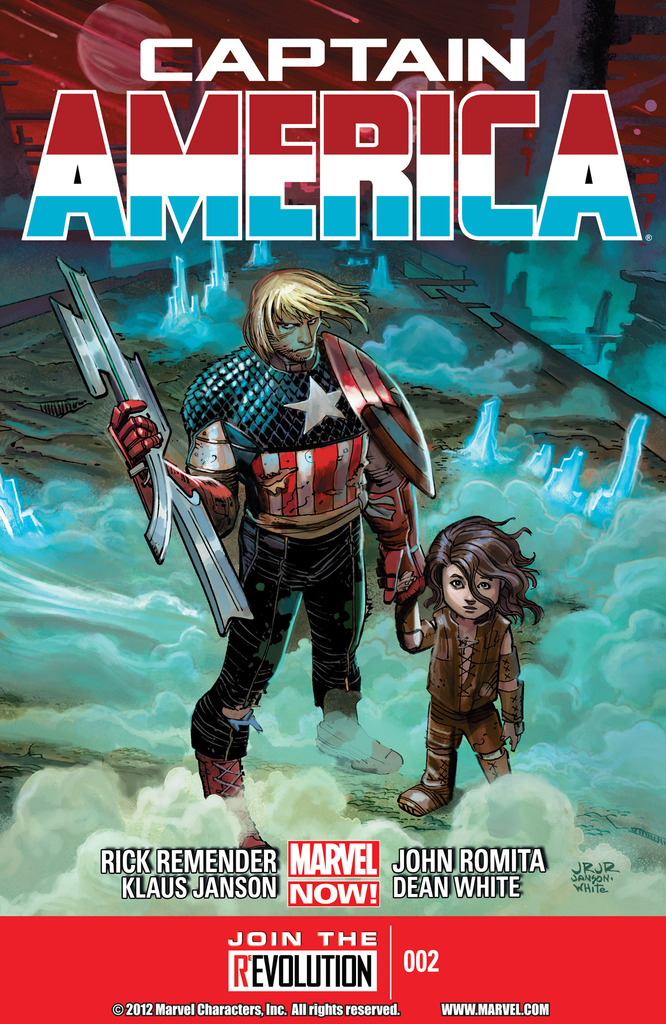
Captain America #002
This issue opens with Cap trapped in the pocket-dimension created by Arnim Zola, trying to escort a young ward he picked up escaping Zola's lab safely back to our own continuum. The landscape and its denizens are all very Kirby, and although I just don't take to JR Jr.'s blocky and line-driven style, it's very skillfully rendered, and he manages to impart the oppressive landscape of the alien dimension very well. Romita's a great storyteller with his art, it's just that it rubs me the wrong way style-wise, which is entirely subjective. Still waiting to see that kid turn into a man-eating beast or turn out to be Zola's child or some such twist. Overall, it's a decent read.
Avengers #002
Man, this is starting to look like an all-Marvel week, huh? Anyway, Hickman's writing, and the art by Opena and White is pretty durn good. The Avengers have decided to "go bigger", and Captain America and Iron Man have put out the call to form a new team. This issue serves as a good reveal for the origin of their current nemeses, a trio of planet-judges, or sort of galactic gardeners bent on reshaping Earth for the better, at the expense of the current Terran status-quo and dwellers therein. I feel that the individual team member personalities are being well cared for by Hickman (was there any doubt?) and although this one is short on the bruises delivered, the story arc is taking shape nicely. "Bigger" does indeed seem to be the tone for the Avengers under NOW!
Supergirl #15
Whew! While I'm still too light on independents, it's nice to at least have both of the Big Two represented. This issue continues the H'el on Earth crossover story line, and unlike the last, seems to really cement Kara as a necessary cog in H'el's plans...plans which, given his disdain for all things non-Kryptonian, will likely result in humans getting the short end of the stick. Johnson's writing delves into more of the life experiences on Krypton which separate Kara from her earth-raised cousin, as well as her immaturity, which leave her more susceptible to H'el's influence. While Asrar's twisty style of pencil-work doesn't always flatter Kara, it does convey her relative youth well, and his facial expressions and panel layouts are spot-on. That, and the inkers (there are three) all seem to know when to add weight and shadow, and when to spare it. A good effort all around.
Image Firsts
Before I go, I gotta mention here that Image has put out reprints of the first issues of many, if not all, of their current series, and they sell for a buck each. In case you've passed over some of the finer works such as Fatale, Thief of Thieves, and Revival, now's you're chance to test the waters before seeking out trades and back issues.
Thanks for reading!
Subscribe to:
Posts (Atom)